Glasses or No Glasses
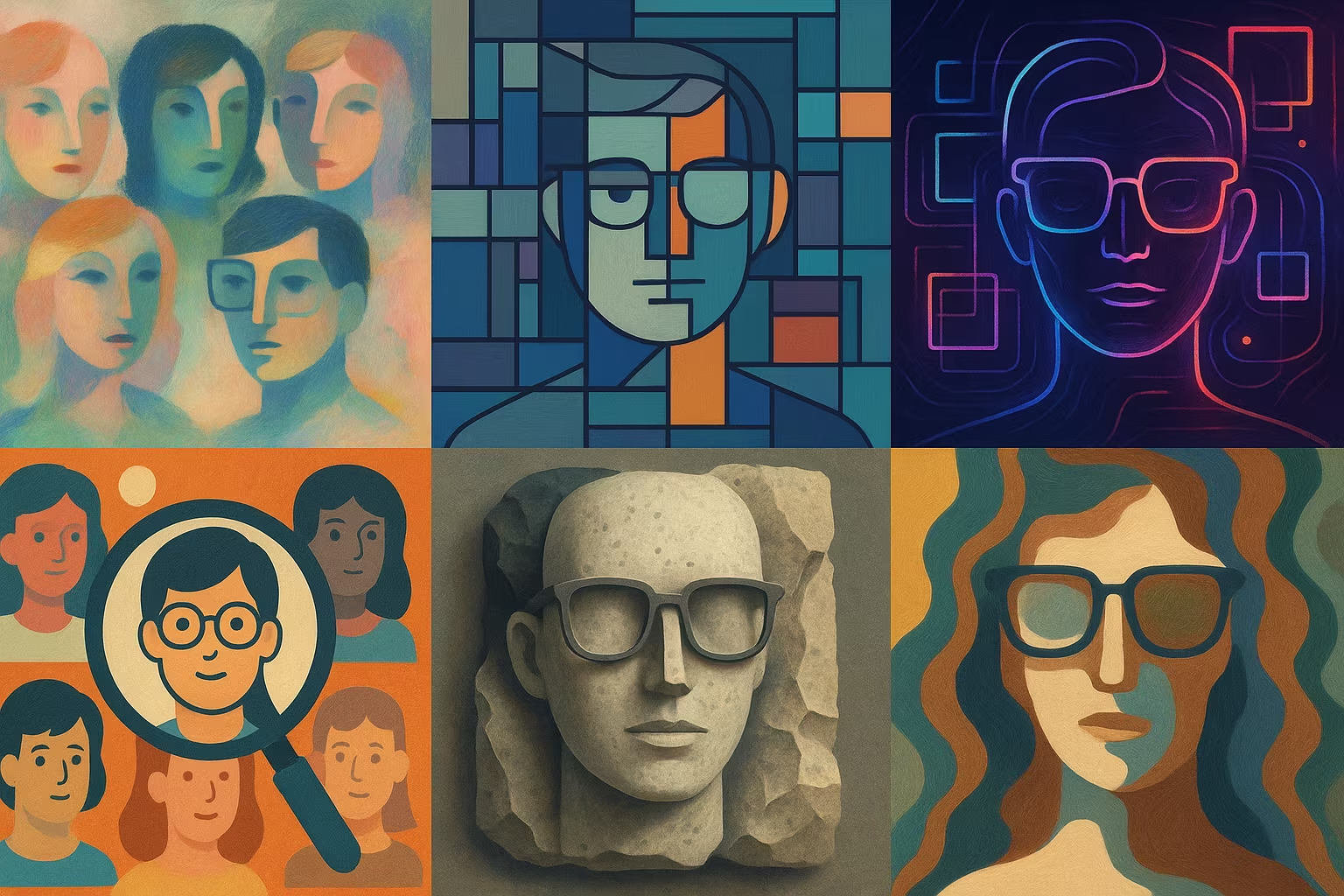
Dataset of synthetic facial images with or without glasses, generated by GAN, designed for supervised visual classification.
Description
This dataset contains more than 5000 images generated by a generative adversarial network (GAN). Each image represents a synthetic face, with a binary annotation: wearing glasses or not. The latent vectors used to generate the images are also provided, allowing for in-depth analyses or generative style transfer.
What is this dataset for?
- Form binary classification models (with or without glasses)
- Testing the robustness of models on synthetic data
- Experimenting with image generation and manipulation via GAN latent vectors
Can it be enriched or improved?
Yes, the dataset can be enriched with additional attributes (e.g. gender, estimated age, synthetic facial expression). It is also possible to generate new images from latent vectors or to interpolate them to create realistic transitions.
🔎 In summary
🧠 Recommended for
- Deep learning students
- Classification pipeline tests
- GAN projects
🔧 Compatible tools
- PyTorch
- TensorFlow
- FastAI
- Keras
- Scikit-learn
💡 Tip
Combine these synthetic images with real photos to test the generalizability of your models.
Frequently Asked Questions
Are the faces in this dataset real?
No, all faces were artificially generated using a GAN, they do not correspond to any real individual.
Can latent vectors be used for reverse generation?
Yes, each image is linked to its latent vector, which makes it possible to explore reverse generation or the manipulation of styles.
Can this dataset be used to train an eyeglass detector in real images?
Yes, but it is advisable to combine it with real data to improve robustness and the ability to generalize.