Data annotation for defense AI: the real story behind modern military technologies

The Pentagon spent $874 million on AI last year. However, this figure doesn't mean much without the process that quietly makes it possible: data annotation!
Drones, autonomous systems, and swarm technologies are projected to reach $1.65 billion by 2030, and none of that works without properly labeled training data. Data annotation involves tagging raw military data (satellite imagery, drone footage, sensor readings) so that AI systems can actually interpret them and act accordingly. It transforms unstructured inputs into structured datasets that help AI models detect threats, track targets, and support decisions where the margin for error is virtually zero.
👉 This article covers the fundamentals of annotation for defense, the security requirements that set it apart from commercial work, and the concrete steps for building annotation programs capable of withstanding operational pressure.
What is data annotation and how does it work in defense AI
The basic data annotation process
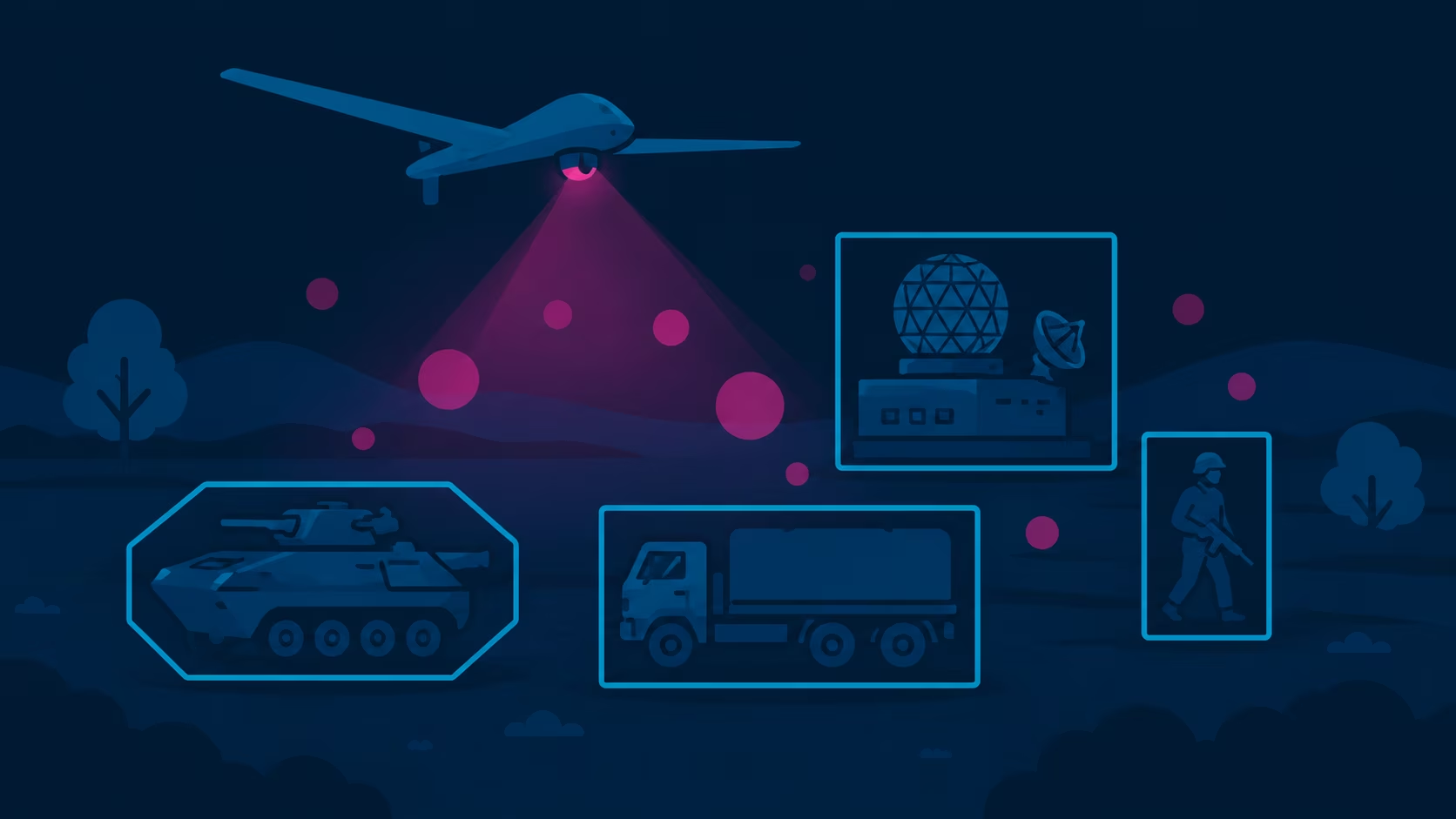
At its core, data annotation adds structured labels and metadata to raw military data, turning it into training material that AI systems can actually learn from. An annotator examines unstructured inputs (satellite imagery, drone video feeds, sensor readings) and marks what matters, embedding human judgment directly into the dataset. Outlining a vehicle in drone footage. Labeling a type of facility in an aerial image. Each action creates a ground-truth signal that determines how a model will interpret similar data at the decisive moment.
The process changes significantly depending on the type of data:
- Image annotation uses bounding boxes and segmentation masks to identify military vehicles, weapons, or infrastructure.
- Video annotation tracks objects consistently from frame to frame, maintaining persistent IDs even when targets are occluded.
- Geospatial annotation links visual data to GPS coordinates and terrain context.
- Text annotation labels keywords and entities in intelligence reports for OSINT feeds.
💡 Each format requires specific techniques and domain expertise. Automated systems regularly miss nuances that a trained annotator knows how to spot.
Why defense AI depends on labeled data
A model only knows what its training data teaches it. Without annotated examples showing what an enemy vehicle looks like from the sky, or how a camouflaged installation appears in infrared, the model has no frame of reference for operational realities. The training process relies on these labeled examples to learn the relationships between visual features and tactical classifications.
If the labels are wrong, the consequences follow. Mistaking a friendly unit for a threat. Failing to spot a concealed adversary. These are not edge cases: they are the predictable results of poor-quality annotation.
This is why defense applications require annotation accuracy exceeding 99%. A model trained on incomplete or low-quality labels will not perform reliably in real-world combat environments. Beyond accuracy, well-annotated data also fosters continuous improvement, helping models adapt to evolving mission parameters and threat profiles.
How annotation differs between commercial and military applications
Commercial annotation typically relies on generalists following categorization guidelines. Defense annotation is on an entirely different level. Military annotators require experience in intelligence analysis to recognize assets from aerial angles where objects look nothing like their ground-level counterparts. Tactical context is not just an asset; it is a fundamental requirement.
Security constraints further widen the gap. Defense datasets contain classified intelligence, weapon system capabilities, and personnel information that commercial annotators never see. Models resulting from this process reflect this difference: they demonstrate a nuanced understanding of strategic scenarios that commercial models, designed for simpler classification tasks, are simply not built to handle.
The main types of data that defense AI systems need to have annotated
Defense AI does not rely on a single data stream. It draws from satellites, drones, ground sensors, radar networks, and open-source text, and each of these sources requires its own annotation approach.
Here is what that looks like for the main data types:
Satellite and aerial imagery annotation
The NGA awarded a $708 million Sequoia contract specifically dedicated to data labeling services to support geospatial intelligence AI capabilities. This scale illustrates just how central aerial imagery is to modern defense AI.
Satellite and aerial imagery annotation allows algorithms to Computer Vision to ensure detection, tracking, object classification, and pattern recognition on wide-area imagery. Annotators mark vehicles, aircraft, ships, weapon systems, and infrastructure using bounding boxes or polygonal masks calibrated to aerial imaging geometry.
SAR imagery adds an extra layer of complexity. Objects appear as backscatter patterns rather than recognizable visual shapes, requiring specialized knowledge from annotators that is genuinely difficult to find.
Drone surveillance video and tracking data
Drone footage requires frame-by-frame annotation to identify vehicles, personnel, and infrastructure across continuous sequences. Multi-object tracking maintains persistent IDs even when targets hide behind obstacles or blend into complex backgrounds.
Over 500,000 hours of drone footage have been labeled for AI model training, across electro-optical, infrared, and synthetic aperture radar sensors. This matters because real-world operational footage captures weather conditions and terrain types that no simulation can replicate.
Multi-sensor fusion for EO/IR systems
Three types of sensors form the foundation of most military perception systems:
- Electro-optical (EO): high-resolution visual imagery for daytime identification.
- Infrared (IR): detection of thermal signatures in darkness, smoke, or obscurants.
- Radar: reliable motion tracking when fog, rain, or dust prevent visual confirmation.
💡 Multi-sensor fusion annotation does not treat these inputs separately. It correlates all three, allowing the AI to cross-reference radar movement with IR thermal signatures and confirm visually via EO when conditions permit.
Geospatial Intelligence and ISR Pipelines
Geospatial annotation links visual data to GPS coordinates, terrain features, and strategic zones, providing intelligence feeds with the spatial context required for utility. Change detection in multi-temporal imagery is particularly demanding. Annotators must account for lighting variations, seasonal vegetation changes, and differences in sensor calibration between captures. The NGA's Maven program integrates these annotated datasets directly into operational analysis workflows.
Ground Vehicle and Tactical Environment Data
Autonomous ground vehicles face terrain that no commercial driving dataset can prepare them for. Military UGVs operating in contested environments-whether transporting equipment or evacuating casualties-encounter obstacles, slopes, and surface conditions unique to active combat zones. Annotation for these systems must reflect this reality, rather than replicating highway conditions.
Text Annotation for OSINT and Intelligence Triage
Defense annotation is not strictly visual. OSINT pipelines process text from audiovisual media, social platforms, and open websites to surface intelligence-relevant signals. Text analysis extracts key themes, sentiment trends, and emerging developments from public domain sources. NLP models built on this annotated text support workflow automation in GEOINT missions, processing volumes that human analysts alone cannot handle.
The Security Requirements That Make Defense Annotation Unique
Data Sovereignty and EU Jurisdictional Requirements
Every link in the defense annotation chain must remain within EU jurisdiction-not just the majority, but all of it. Annotators must be EU citizens or residents, working from EU sites, under EU contracts. US-based annotation pools do not meet this requirement, regardless of their structure. Exposure to the CLOUD Act means that data processed by European subsidiaries of US companies remains accessible to US authorities. This is a deal-breaker for classified imagery and sensitive geospatial work.
Infrastructure requirements go further than most programs anticipate. Prompt storage, response logs, and platform architecture must all reside within EU cloud regions, under legal structures established in the EU. European defense programs now write EU sovereign annotation directly into procurement specifications. If you treat sovereignty as an afterthought, you are already behind.
Annotator clearance and residency constraints
Anyone handling classified data-whether federal agents, contractors, or military personnel-must undergo formal security vetting. The sponsoring agency sets the level of investigation based on the potential damage a given position could cause. These investigations cover criminal records, judicial files, employment history, and educational institutions.
In practice, verification goes beyond paperwork. Comprehensive KYC checks, confirmation of current residency, criminal record certificates, and references from previous employers are all standard requirements. Annotator verification is not a one-time check; it is an ongoing program requirement.
Audit trails and compliance documentation
DoD metadata standards mandate fields for security classification, disclosure, communicability, and processing restrictions on annotated data. An audit trail must be able to answer six questions for every label: who created it, when, according to which version of the guidelines, through which review stages, and whether it met quality criteria.
This is not just about internal governance. Article 10 of the EU AI Act makes documented data practices a legal requirement for bringing high-risk AI to market. Full enforcement begins on August 2, 2026, meaning programs building their annotation pipelines today need compliant documentation practices now, not at the time of deployment.
Infrastructure and platform security measures
Physical security for on-site annotation teams typically includes no-phone policies, CCTV surveillance, biometric access controls, and restricted-access company hardware. For remote annotators handling sensitive data, VDI solutions keep all information on protected servers, with nothing residing on local machines.
💡 At the platform level, PCI DSS Level 1 and ISO 27001 certifications are baseline expectations, alongside GDPR, CCPA, and HIPAA compliance. These are not optional accreditations. They are the minimum requirement.
Developing annotation capabilities for defense programs
In-house vs. external annotation teams
Every defense program eventually faces the same decision: build an in-house annotation capability or partner with an external provider. This choice determines your speed of execution, the level of control you retain, and the robustness of your models under pressure-often for years to come.
In-house teams offer clear advantages. Annotators who share the engineers' operational context shorten iteration cycles. Sensitive imagery remains within a more restricted access perimeter. Control over guidelines stays in the hands of those who understand mission requirements firsthand.
The limitation, frankly, is that developing an annotation capability is a fundamentally different discipline from building AI systems. Most defense teams do not count annotation methodology among their core competencies, and attempting to build it from scratch while running active programs is costly and time-consuming.
External partners effectively fill specific gaps: surge capacity during large labeling campaigns, methodological depth that small internal teams cannot replicate, and independent validation that holds up during procurement reviews.
The model that most mature defense programs converge on is a hybrid approach. The internal team handles the most sensitive labeling and maintains control over annotation guidelines. The external partner manages scale and specialized coverage. Neither operates in isolation.
Quality control standards for operational AI
Annotation accuracy must exceed 99% for operational defense AI-not as an ambitious goal, but as a baseline requirement. The gap between 97% and 99% accuracy may seem minimal. At scale, across thousands of images and intelligence inputs, it is not.
Multi-level review processes route every annotation through an annotator, a reviewer, and a defense-trained quality manager. Measuring inter-annotator agreement surfaces quality issues before they reach model training. Consensus labeling addresses contested labels where subjective judgment varies from one annotator to another.
Every step exists because errors detected late are far more expensive than those caught early, in terms of rework, retraining, and operational risk.
Common pitfalls in defense programs
These patterns recur repeatedly in programs that struggle to ensure the quality of their annotation:
- Generalist annotators assigned to specialized work. Edge cases quickly reveal the gap, and by then, the model has already been trained on flawed data.
- No tracking of inter-annotator agreement. Quality issues remain invisible until deployment brings them to light.
- Annotation guidelines without version control. Data labeled according to different standards ends up mixed in the same training set without anyone noticing.
- Sovereignty treated as a mere checkbox during procurement. When compliance gaps appear after a vendor is chosen, the rework is costly and delays are very real.
Launching your first defense annotation project
- Start with a pilot project of 1,000 to 5,000 examples. Use it to test the methodology before committing resources on a large scale.
- Define annotation guidelines with version control from the very first labeled example.
- Set sovereignty constraints during the vendor pre-selection phase, well before the request for proposal stage.
- Align data modalities with operational use cases so that annotation priorities reflect actual mission requirements, not just data availability.
- The pilot phase is when the methodology is calibrated. Skipping it to go faster almost always results in slowing down at a later stage of the project!
Conclusion
Defense annotation is not an administrative data management task. It is what distinguishes an AI system that holds up under pressure from one that fails at the most critical moment.
Our standards are non-negotiable: over 99% accuracy, sovereign infrastructure, domain-expert annotators, and version-controlled guidelines from day one. Sovereignty is not a checkbox in the procurement process. Specialized annotators are not a premium add-on. They are baseline requirements.
Start with a targeted pilot. Refine your methodology before scaling. Combine internal oversight with external capacity deliberately, not reactively. Programs that treat annotation as a strategic capability rather than an afterthought are the ones whose AI systems hold up when the operational stakes are real.


