
World Models: Understanding the New Frontier of AI

🌍World Models: Understanding the new frontier of AI
Following the wave of large language models (LLMs), a new paradigm is taking hold in artificial intelligence research: the world model. By 2026, this approach has become one of the most competitive areas of research in the sector, driven by players like Google DeepMind, NVIDIA, Meta, and Yann LeCun's new startup, AMI Labs. This technical article breaks down what a world model is, the competing architectures, and the concrete applications emerging today.
What is a world model?
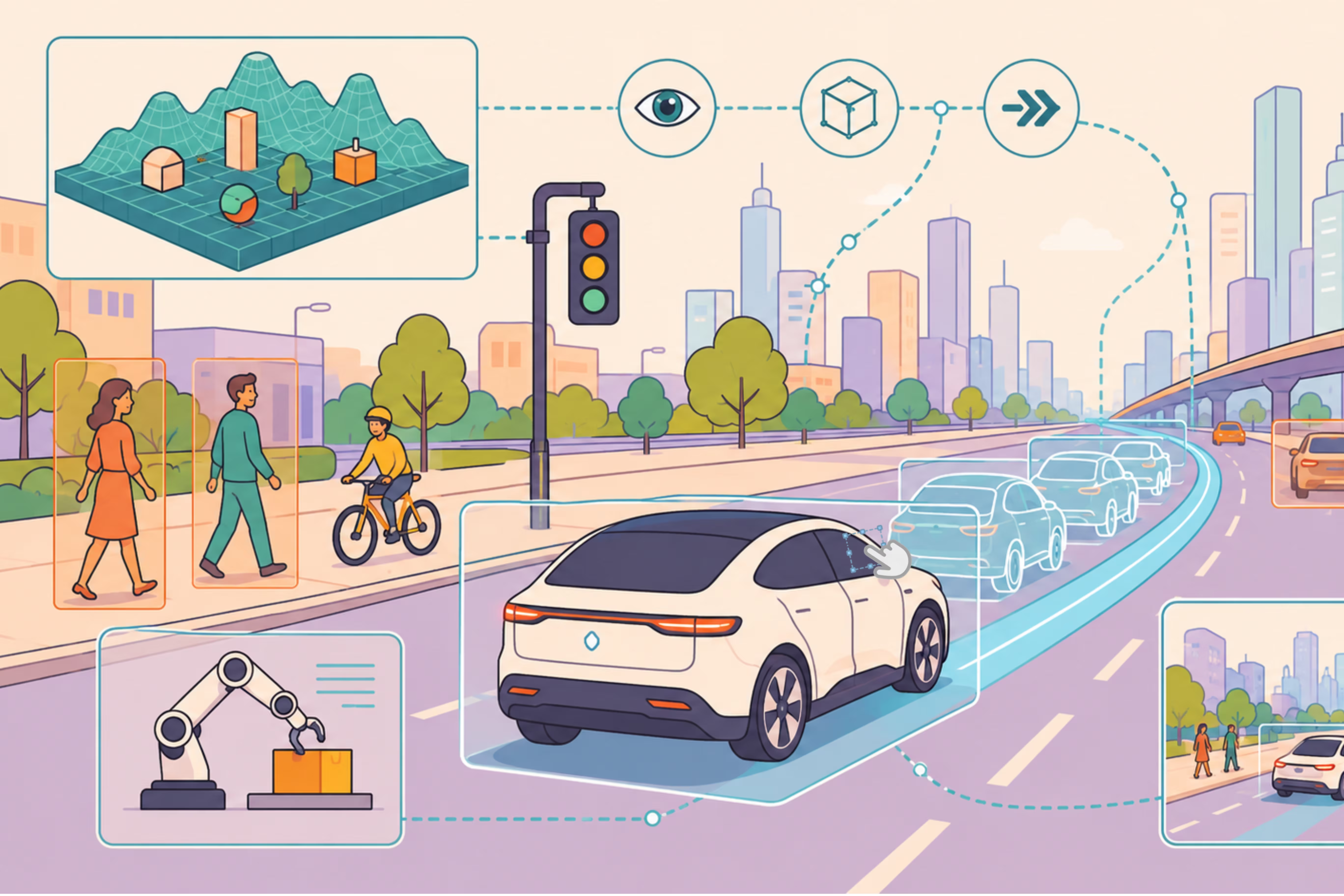
A world model is an internal simulator that learns how an environment functions in order to predict how it evolves over time based on observations and actions. In other words, the model builds an internal representation of reality that allows it to anticipate the consequences of its actions before executing them.
This capacity for prediction and planning fundamentally distinguishes world models from LLMs. A language model predicts the next token in a text sequence; a world model, meanwhile, predicts the next state of a physical or visual environment. Where an LLM manipulates symbols, a world model aims to capture the causal laws and dynamics of reality: gravity, object permanence, and the continuity of motion.
The concept is not new. It dates back to the work of Jürgen Schmidhuber and was popularized by the 2018 paper "World Models" by Ha and Schmidhuber. But it was the availability of massive video data, improvements in architectures, and the surge in computing power that transformed this theoretical idea into an operational reality in 2025-2026.
Why world models after LLMs?
The central argument in favor of world models is strongly championed by Yann LeCun. His thesis: LLMs, as impressive as they are, cannot reach human-level intelligence on their own. They excel at manipulating language but lack any robust understanding of the physical world, nor do they possess true causal reasoning or long-term planning capabilities.
This conviction led to a resounding financial bet. In November 2025, LeCun left Meta to found AMI Labs (Advanced Machine Intelligence Labs), a startup entirely dedicated to world models. In March 2026, it closed a $1.03 billion seed round at a $3.5 billion pre-money valuation—the largest seed round in the history of European startups.
The bet is simple to state but carries heavy consequences: if the future of general AI lies in understanding the physical world rather than just predicting text, then world models will become the fundamental infrastructure of the next decade.
The two major architectural approaches
The field of world models is shaped by a deep disagreement over the best way to represent the world. Two philosophies are clashing.
The latent representation approach (JEPA, Dreamer)
The first school of thought seeks to capture the structure of the world in an "abstract latent space," without reconstructing every pixel. This is the approach taken by LeCun's Joint Embedding Predictive Architecture (JEPA) and Danijar Hafner's Dreamer models.
The technical argument is as follows: in a video, most of what happens—the rustling of leaves, the flickering of light, the individual movement of air molecules—is inherently unpredictable. A system that attempts to reconstruct every pixel wastes its capacity predicting irrelevant noise. JEPA bypasses this by predicting abstract representations of future states rather than their exact visual rendering.
V-JEPA 2, unveiled by Meta, illustrates this approach: trained on over a million hours of internet video, it learns to predict the future representations of a scene in an embedding space. Fine-tuned on less than 62 hours of robotic trajectories, it achieves state-of-the-art performance in action anticipation and zero-shot robotic planning.
The pixel-space generative approach (Sora, Genie)
The second school takes the opposite path: explicitly generating the future image, frame by frame, and using this rendering as a simulator in itself. This is the path taken by OpenAI's Sora, presented as a "world simulator," and Google DeepMind's Genie.
Genie 3 marks a significant breakthrough: it is the first interactive, general-purpose, real-time world model. It produces navigable, photorealistic 3D worlds at 24 frames per second from a simple text prompt, which can be explored live—whereas previous systems generated static environments or required significant processing time.
The debate between these two camps (pixel-perfect generation versus abstract latent representation) remains open and currently constitutes the main fault line in research toward AGI.
Key players and models in 2026
Beyond this architectural dichotomy, several systems are shaping the current landscape of world models:
- NVIDIA Cosmos : an open-weight World Foundation Model (WFM) platform trained on massive volumes of robotics and driving data. Cosmos supports Text2World, Image2World, and Video2World generation with a strong sense of physical awareness.
- World Labs (Marble) : launched in November 2025 by Fei-Fei Li, Marble generates complete 3D worlds from text, images, short videos, or 3D sketches, and exports them as Gaussian splats, meshes, or controllable-camera videos. World Labs raised over $1 billion in early 2026.
- DeepMind Genie 3 and OpenAI Sora for the generative path.
- Meta V-JEPA 2 and AMI Labs for the latent path.
Real-world applications of world models
Far from being a laboratory abstraction, world models are already finding major industrial applications.
- Autonomous driving. In February 2026, Waymo has adopted Genie 3 to build its own "Waymo World Model," dedicated to driving simulation. It produces synchronized camera and lidar outputs and generatesedge casesthat robotaxis rarely encounter in the real world—a way to train and validate driving systems at scale and at a low cost.
- Robotics. V-JEPA 2-AC, an action-conditioned variant, allows real robots to perform pick-and-place manipulation tasks in a zero-shot manner, in unknown environments, without specific retraining. This is a decisive breakthrough for generalization in robotics.
- Content generation and gaming. The generative power of Sora and Genie paves the way for interactive environments, simulations, and game worlds generated on the fly.
These applications fall under what the industry now callsphysical AI: systems capable of acting in the real world because they understand its dynamics.
The central role of data in training world models
A point often underestimated: the quality of a world model depends directly on the quality of the data it is trained on. Predicting the dynamics of the physical world requires carefully collected and often annotated datasets of video, robotic trajectories, and driving scenes. Edge cases—precisely those that world models seek to simulate—must be identified and structured within the training and evaluation data.
This is why the rise of world models is accompanied by a growing demand for specialized data annotation : video segmentation, action labeling, 3D and lidar annotation, and human validation of generated scenarios. The robustness of future world models largely depends on this stage.
Current limitations and challenges
World models remain a nascent technology. A benchmark published in May 2026 showed that current models remain fragile when faced with novel situations, struggling to maintain physical consistency over long sequences. Temporal consistency, long-term memory, and objective performance evaluation are among the open problems. Furthermore, the fundamental architectural disagreement remains unresolved: no one yet knows whether the latent path or the generative path—or a hybrid of the two—will lead to artificial general intelligence.
Conclusion
The world model represents a major shift in perspective: moving from an AI that manipulates language to an AI that understands and simulates the world. Driven by record investments and already tangible applications in autonomous driving and robotics, this approach could well be the next major step after LLMs. The coming years will determine which architecture prevails—but one thing is certain: world models are now at the heart of the race toward artificial general intelligence!
---
Sources : Google DeepMind (Genie 3), Meta AI (V-JEPA 2), NVIDIA (Cosmos), World Labs (Marble), TechTimes (AMI Labs), Wikipedia, arXiv.


