
Legal DataAnnotation: How to Build High-Quality Legal Datasets for AI

ℹ️ Key Takeaways
• Legal data annotation is the labeling of legal documents — contracts, case law, filings — to create training data for legal AI systems.
• It powers contract review, e-discovery, legal research tools, compliance monitoring, and legal chatbots — a legal AI market growing at over 17% per year.
• Its defining constraint: annotators need genuine legal knowledge. A bounding box can be drawn by anyone; a governing-law clause cannot be tagged by someone who has never read one.
• Confidentiality is non-negotiable: legal documents carry privilege and personal data, demanding strict security protocols, NDAs, and often anonymization before annotation.
• Quality comes from legally trained annotators, precise guidelines, inter-annotator agreement measurement, and expert review — not from crowdsourcing.
What is legal data annotation?
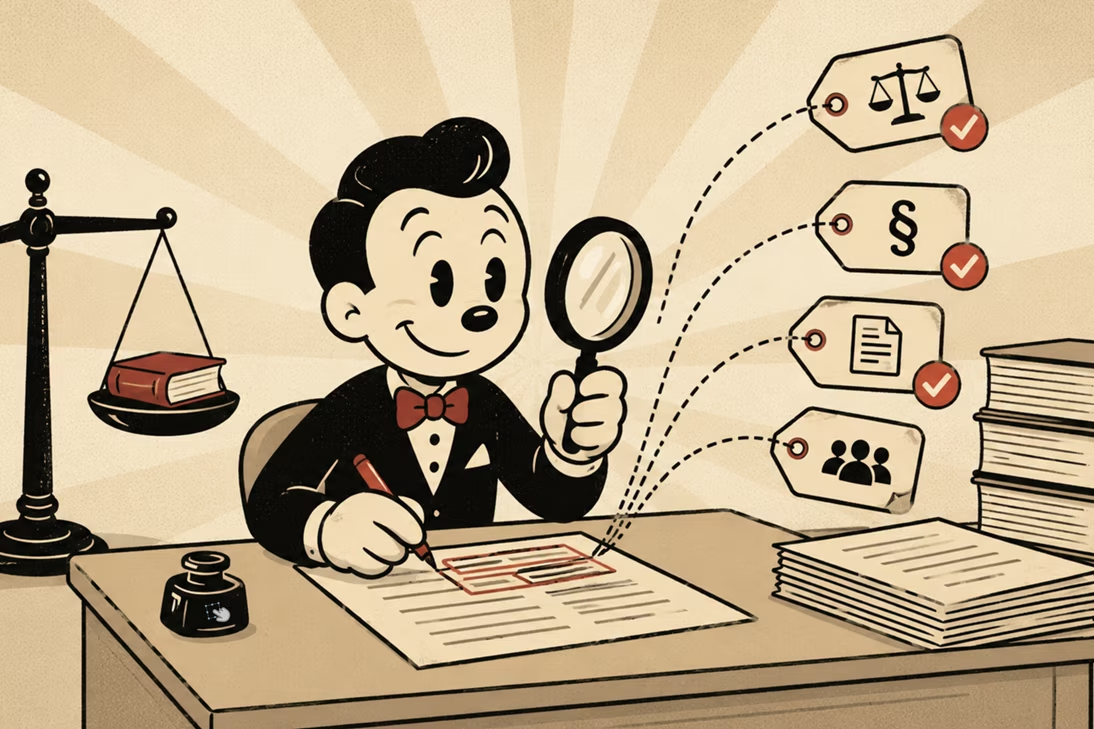
Legal data annotation is the process of labeling legal documents — contracts, court decisions, statutes, filings, and correspondence — so that machine learning models can understand and process legal language. Annotators tag entities (parties, dates, jurisdictions), classify clauses and documents, mark obligations and risks, and redact personal data, turning unstructured legal text into structured training datasets for AI.
💡 The demand is growing fast. According to Grand View Research, the global legal AI market was valued at $1.45 billion in 2024 and is projected to reach $3.9 billion by 2030, growing at 17.3% per year. Every one of those tools — contract analyzers, research assistants, e-discovery platforms — learns from annotated legal data. In short: legal data annotation is the invisible foundation of the legal AI boom.
-hand-innv.png)
Why does legal AI depend on annotated data?
Legal language is a world of its own: dense, jurisdiction-specific, full of terms whose legal meaning differs from everyday usage (“consideration”, “execution”, “instrument”). A general-purpose model reads legal text; it does not understand it.
Annotated legal datasets are what teach models the difference. The main applications:
• Contract review and analysis. Models trained on clause-annotated contracts can locate termination rights, liability caps, or auto-renewal traps in seconds across thousands of agreements.
• E-discovery. Relevance and privilege annotations train systems that triage millions of documents in litigation, an application where errors have direct procedural consequences.
• Legal research. Case-law annotated with issues, holdings, and outcomes powers research tools that find genuinely analogous precedents rather than keyword matches.
• Compliance monitoring. Regulatory texts annotated with obligations and applicability let systems map new rules onto a company’s actual duties.
• Legal chatbots and copilots. Question–answer pairs and instruction data written and validated by legal professionals keep assistants accurate — and aware of what they must not answer.
What are the main types of legal data annotation?
Named entity recognition (NER) for legal text
Tagging parties, judges, courts, dates, amounts, statutes, and case citations. Legal NER goes beyond generic NER: “Article 17” may be a statute, a contract clause, or a GDPR provision, and only context — read by a trained annotator — decides.
Clause and contract annotation
Labeling clause types (indemnification, limitation of liability, governing law, confidentiality), their attributes (unilateral or mutual, capped or uncapped), and deviations from a playbook standard. This is the backbone of contract-review AI.
Document classification
Sorting documents by type (motion, opinion, exhibit, NDA, lease), practice area, jurisdiction, or relevance — the workhorse annotation of e-discovery and document-management systems.
👉 Discover our documentation classification services here
PII redaction and anonymization
Identifying and masking names, addresses, and identifiers in legal documents — required both to protect data subjects and, frequently, as a precondition for using the documents in training at all.
Summarization and argument annotation
Writing reference summaries of decisions, and marking argumentative structure — claims, reasoning, holdings — to train models that brief cases rather than merely retrieve them.
Evaluation data for legal LLMs
The newest category: legally trained annotators scoring model outputs for accuracy, hallucinated citations, and jurisdictional validity, producing the ground truth against which legal AI systems are benchmarked and fine-tuned.
What makes legal data annotation so challenging?
• Expertise is mandatory. Distinguishing an indemnity from a warranty, or dicta from holding, requires legal training. Generic annotation workforces produce confident, wrong labels — the most expensive kind.
• Confidentiality and privilege. Legal documents are among the most sensitive data that exists. Annotation requires NDAs, access controls, secure environments, audit trails — and often prior anonymization. Anonymous crowdsourcing is disqualified from the start.
• Genuine ambiguity. Lawyers themselves disagree on classifications. Guidelines must define how to handle edge cases, and inter-annotator agreement must be measured rather than assumed.
• Jurisdiction and language. A clause standard in New York may be unenforceable in Paris. Datasets must be annotated by people who know the relevant legal system — and, for multilingual corpora, the legal terminology of each language, not just the language itself.
• Bias with consequences. Skewed training data in legal AI can systematically disadvantage categories of parties. Careful sampling and bias review during annotation is an ethical requirement, not a refinement.
Who should annotate legal data — and how?
The workable model is a hybrid team: annotators with legal backgrounds (law graduates, paralegals, legal ops professionals) handle volume production; qualified lawyers define the guidelines, adjudicate edge cases, and review samples; and annotation engineers run the tooling and quality metrics. This is the approach we apply at Innovatiana [→ hire annotators here]: domain-trained data annotators working under expert supervision, within strict security protocols.
The process that produces quality: (1) precise annotation guidelines with worked examples and edge-case rules, written with legal experts; (2) a pilot round on a small sample to surface ambiguities early; (3) a gold-standard set for calibration; (4) production with continuous inter-annotator agreement measurement; (5) expert review of samples and all flagged items; (6) guideline updates as new edge cases emerge. In short: treat the guidelines as a living legal document — because that is what they are.


